Editorial policy
How we decide what makes it into an issue, and what we leave out.
The one question
Every candidate story gets the same question, and it decides everything else:
We are not reporting AI news. We are filtering it for business relevance. Most AI news does not qualify, and that is the point. The publication is useful because of what it excludes.
What normally goes in, and what normally doesn't
These are examples of the kinds of story on each side, not a definitive list. Judgement still applies to every item.
| News | Include? | Why |
|---|---|---|
| New feature that analyses company data | Yes | Businesses can use it |
| Messaging platform launches AI customer-service capabilities | Yes | Direct application for small firms |
| UK changes AI or privacy guidance | Yes | Businesses may need to act |
| A widely used tool adds useful automation | Yes | Immediately usable |
| AI tool prices fall sharply | Yes | The purchasing decision changes |
| Major AI security vulnerability | Yes | Risk or action required |
| New AI grant or training for UK businesses | Yes | Free money or help |
| Practical business AI case study | Yes | Teaches something usable |
| New benchmark record | No | Usually irrelevant |
| Research model with a 2% improvement | No | No action follows |
| Executive drama | No | Entertainment, not business |
| Large startup funding round | No | Usually irrelevant to readers |
| Rumoured product release | No | Wait until it is real |
| A long list of new AI tools | No | Noise |
The filter behind the filter
One more question removes the majority of what survives the first:
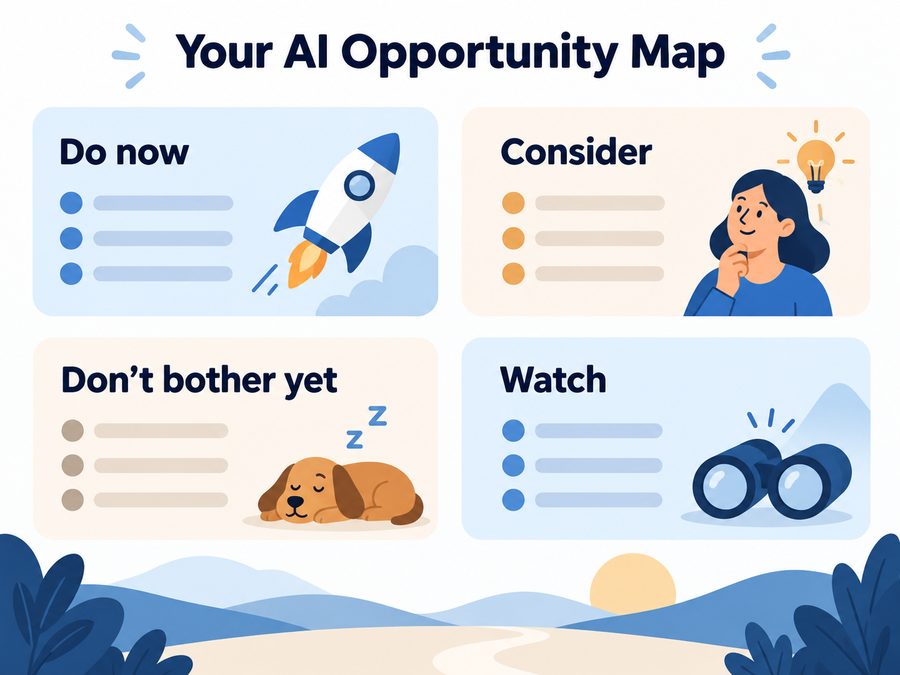
Length
800–1,200 words maximum. One email a week, about a five-minute read. Do not make it an endless newsletter. If a week produces nothing important, the issue is shorter rather than padded.
The UK subjects we watch
Every UK item comes from this list, and only this list:
government guidance, ICO, CMA, NCSC, grants, funding, training, tax, regulation, research or UK adoption.
This section is permanent in every issue. It is the part readers cannot get anywhere else in one place, and it is why the briefing is specific to Britain rather than to AI in general.
Sources
We prefer the source closest to the fact. In order:
- Original product or company documentation, release notes and announcements.
- UK government, regulator and security sources: DSIT, ICO, CMA, NCSC, HMRC, Innovate UK, Skills England and others.
- High-quality independent reporting.
- Independent technical or user verification.
- Social and community sources as discovery signals only, never as evidence.
Where the original is not available, we say so. We do not cite an aggregator in place of the source.
What we leave out as a matter of course
- Rumours and unconfirmed product releases.
- Benchmark records with no business consequence.
- Executive gossip and personnel drama.
- Generic funding announcements with no reader consequence.
- Duplicated stories. One development is one entry, however many outlets covered it.
Claims, sponsorship and corrections
- We distinguish confirmed fact, company claim and our own interpretation.
- We do not publish subscriber numbers we cannot substantiate.
- We do not invent testimonials, case studies or media endorsements.
- Sponsored content is always labelled. We do not sell rankings or coverage.
- Affiliate or commercial relationships are disclosed in the issue where they apply.
- When we get something wrong, we correct it visibly: in the next issue, and on the web version of the issue concerned.
The format
One email a week, about five minutes to read, 800–1,200 words. It is deliberately short: it is a briefing, not a feed. If a week produces nothing important, the issue is shorter rather than padded.